
August 6, 2025
Reading Time: 8 minutesBy Joshua Zinder, AIA, NCARB, LEED AP
AIA-NJ Past-President, Managing Partner, JZA+D, Princeton, N.J.
This article is the second in a planned three-part series – the first, “Missing-Middle Solutions for Achieving State-Mandated Affordable Housing Requirements,” was published on May 20, 2025. Look for the final installment, “Site-Selection for Creative Housing Solutions,” to follow soon.
Municipalities across New Jersey currently face Fair Housing Act Fourth-Round obligations totaling more than 84,000 units statewide. Developing and building this number of units by 2035 will require an “all of the above” strategy that combines new single-family homes with mid-rise apartment buildings – defined as being between 5-12 stories or over seventy-five contiguous residential units – plus everything in between.
As discussed in Part 1 of this series, architects addressing housing development opportunities in the missing middle are helping create the kinds of communities many say they want: affordable, sustainable, walkable, and diverse with primarily house-scale development. Of course, there are sites and contexts in many municipalities where mid-rise apartment buildings are both feasible and the most effective solution. And yet, challenges and impediments remain, tasking architects to partner with developers and state and local agencies to identify workable paths.
The large size of mid-rise developments often scares neighbors and overwhelms communities. However, they are often the most effective path to allow a municipality to meet its affordable housing obligations while also allowing developers to build more market-rate units and thereby mitigate any potential financial downside of the affordable units. These projects often secure PILOT (Payment In Lieu Of Taxes) money, which incentivizes building higher-density developments to meet the municipal goals and state requirements.
“Many projects that could be affordable and mixed-income mid-rise are in areas [of New Jersey] that have been zoned to permit it, but where the majority of the existing housing stock is smaller and lower density,” says Jak Inglese, AIA, PE, LEED AP, Senior Partner with Inglese Architecture + Engineering. This is most often the case with transit-oriented redevelopment sites, he adds. And according to Matt Jarmel, AIA, President of Jarmel Kizel Architects, the state’s zoning ordinances lack flexibility, often limiting housing to “single family, townhomes, garden homes and large-scale multifamily,” with little room for mid-rise construction.
Mid-rise development often runs up against NIMBYism. David J. Minno, AIA, PP, offers this brief list of typical objections to mid-rise development from neighboring residents:
Thriven Design Principal Stephen L. Schoch, AIA, LEED AP adds, “Some towns are proud of being defined by their low-height and low-density regulations, claiming ‘small town’ status even within the most densely populated state in the country.” Schoch notes that municipalities with strong historic fabrics can be especially challenging. “They often view anything mid-rise as a direct challenge to the core identity of their community.”
Winning approvals for Mid-Rise
Moving projects through the approvals process is really where the rubber meets the road, because it is there that designs and plans run up against both zoning policies and community resistance. The latter is especially important for architects and their developer partners to consider, and the best way to ensure success is to “do your research,” says Jessica O’Donnell, AIA New Jersey’s 2025 President-Elect. “Talk to community members,” she says, “and do not simply insert what you think works based on a similar project from a similar town. A well- designed building will complement the existing neighborhood fabric while respectfully pushing the boundaries.”
Claudia Bitran, AICP, PP, Senior Associate and Director of Planning for Thriven Design concurs with O’Donnell that designing to complement and enhance the existing fabric of the community is the key to approvals. Says Bitran, “Communities support projects that are sensitive to their physical and cultural environment, and which give careful attention to the potential side effects and concerns associated with development.” She proposes considering every way in which the site and building design impacts community perception, from traffic and access to materials and landscaping. She also encourages the inclusion of community-oriented services and amenities in the mid-rise design, if possible.
Minno adds that designs should acknowledge the existing architectural context “in terms of materials and historic styles,” and suggests including step-back at the rooflines to visually diminish the project scale.
Preparation for Presentations
Being able to explain step-backs and other architectural gestures in a meeting is also critical, because the lay person may not see why it matters. In addition, Minno says, “the project team should be ready with good technical and engineering responses to questions about traffic and drainage issues and offer expert testimony refuting concerns about the diminishment of property values. Bring fiscal impact statements that show the project will be a net tax ratable for the municipality.
Presenting at meetings and hearings is critical In providing project information to the community. The success of the storytelling is a linchpin in gaining support and approvals. Inglese suggests that preparation for these meetings is not just about a great slide deck – it is about laying the groundwork in advance: “Meet with whatever local community groups there are, to be able to say that you presented it and fielded their input. And have the local planning staff on your side – if they have seen your project and support the development, it goes a long way towards swaying the approving body.”
And it cannot hurt to “be deferential,” Minno notes, “and have a full understanding of the facts surrounding the property including land uses and roadway systems.”
As for the presentation itself, all agree that graphics and visual aids are invaluable. “With all the tools we have at our disposal today, there’s no real excuse for not having a strong image or two at public hearings,” says Schoch, adding that an overhead view of the building set into its surrounding is an effective tool for proving a building design isn’t as big and overwhelming as the community might initially perceive it to be.
Condominiums as Mid-Rise Solutions
Most of the discussions around affordable housing development centers on rentals, but homeownership should be affordable, too. The question is whether condominiums are an appropriate development approach for mid-rise projects – some, like Inglese, feel that condominiums in the affordable housing context are more appropriately sized for the missing middle.
“I’ve had smaller not-for-profit developers that transitioned from one- and two-family dwellings to small multi-family projects that are then sold as condominiums,” he relates. “It’s a niche that works for sites and developers that don’t fit the Low-Income Housing Tax Credit route but can use multiple smaller funding sources.”
The real issue with condominiums, according to Minno, may be that most municipalities need affordable family rentals to meet the state requirements. “Larger condominium communities have more difficulty in making their financial proformas work when affordable units are required,” he says. Schoch adds to this that while some new subsidy programs offer tools for developers trying to get into the affordable homeownership market, the real problem is how shallow the pool of buyers is typically – since qualifying means earning a target percentage below the Area Median Income or AMI (a common benchmark for determining income eligibility) while also boasting good enough credit for a mortgage.
“One key challenge with condos,” adds Schoch, “is that they have common community elements that residents have shared responsibility to upkeep and maintain. If one is coming from a rental background, the upkeep of these elements and participation in a condominium association can add layers of complexity to the home ownership experience.”
Locating mid-rise housing at or near shopping centers and downtowns can be an effective solution in many communities. In Princeton, examples include the new Avalon and the Alice at the Princeton Shopping Center, while in Somerville, there are the Edge at Main and the Davenport. These developments enrich existing communities in urban and semi-urban environments by adding density in areas with supporting infrastructure. Mid-rise condominiums and rentals paired together can also be strong community builders: at the Princeton Junction train station in West Windsor, developments currently under construction include Avalon Squared, offering rental units alongside condominiums by Pulte Homes. These mid-rise residences will serve as the backbone for a new town center development in the community.
Whether they are rentals or condominiums, mid-rise housing can be the critical component and tool for municipalities to resolve their housing challenges. Leveraging locations that already have some density as a way to increase density may encounter less resistance than placing midrise developments in suburban or rural contexts. Understandably, most communities are resistant to change – we get used to the places we grew up and where our children played as they were, and accepting change is sometimes difficult. But adding housing units in our communities allows more people to share those special experiences and opportunities we enjoyed. The challenge of sufficient housing in New Jersey is not going away any time soon, and midrise developments are a critical tool to achieving goals and complying with our obligations under state law.
CASE STUDIES:
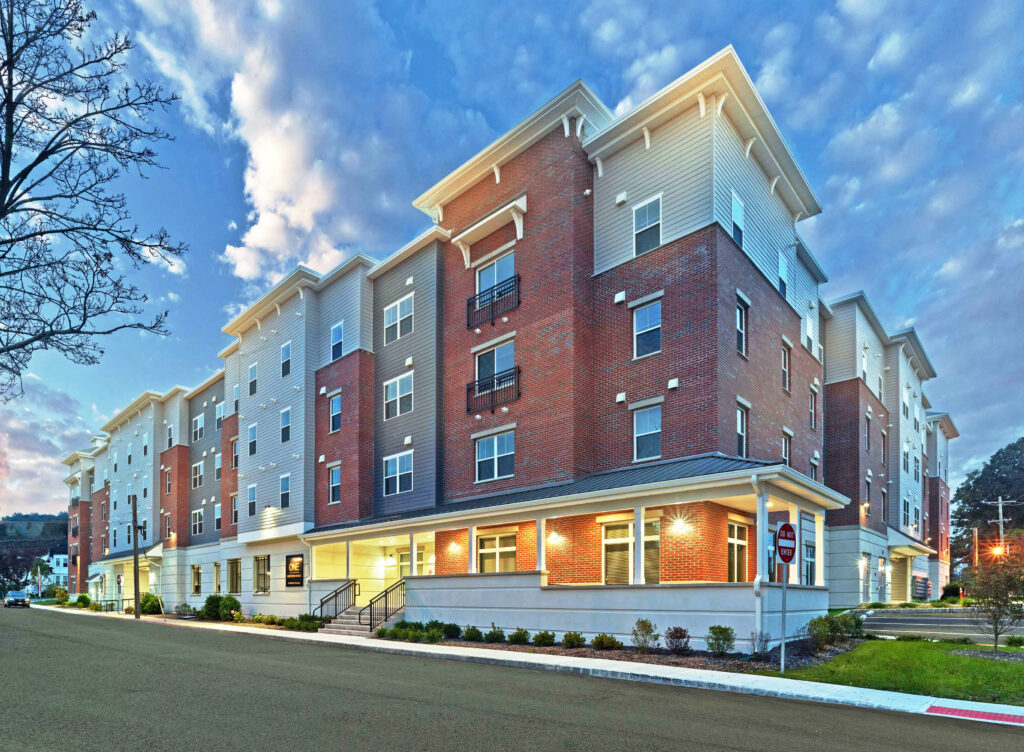
Project Credit: Thriven Design. Photo credit: Don Pearse Photographers
One Thompson Avenue, Dover, NJ, Thriven Design
One Thompson Ave is an award-winning affordable housing community in Dover, NJ, that repurposed a previously underutilized municipal parking lot to create 70 units of affordable multifamily housing with 100 percent of the units affordable to residents with household incomes at or below 60 percent of the Area Median Income (AMI) and five percent of the apartments designed to be accessible to residents with physical disabilities. Veterans are given preference on 50 percent of the units, and five units are set aside for residents who formerly experienced homelessness. Thriven Design provided planning and architectural services for the project, which was the first affordable housing development in Dover in over a decade.” The project received a New Jersey Smart Growth Award in 2023.
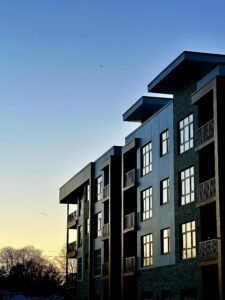
Project and Photo Credit: PS&S Architecture & Engineering
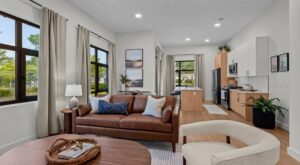
Photo Credit: LiveTheAlice.com
The Alice Princeton, NJ, PS&S Architecture & Engineering
Located at the Princeton Shopping Center, The Alice Princeton is a 125-unit market-rate multifamily apartment building that was part of the collaborative development team that won a 2024 Smart Growth award. The building has a mix of 1-2-3-bedroom units along with a multitude of interior and exterior amenities for its residents. The exterior elevations undulate throughout the building to break up the overall length and also include a variation in materials to provide a dialogue between texture and contrast.
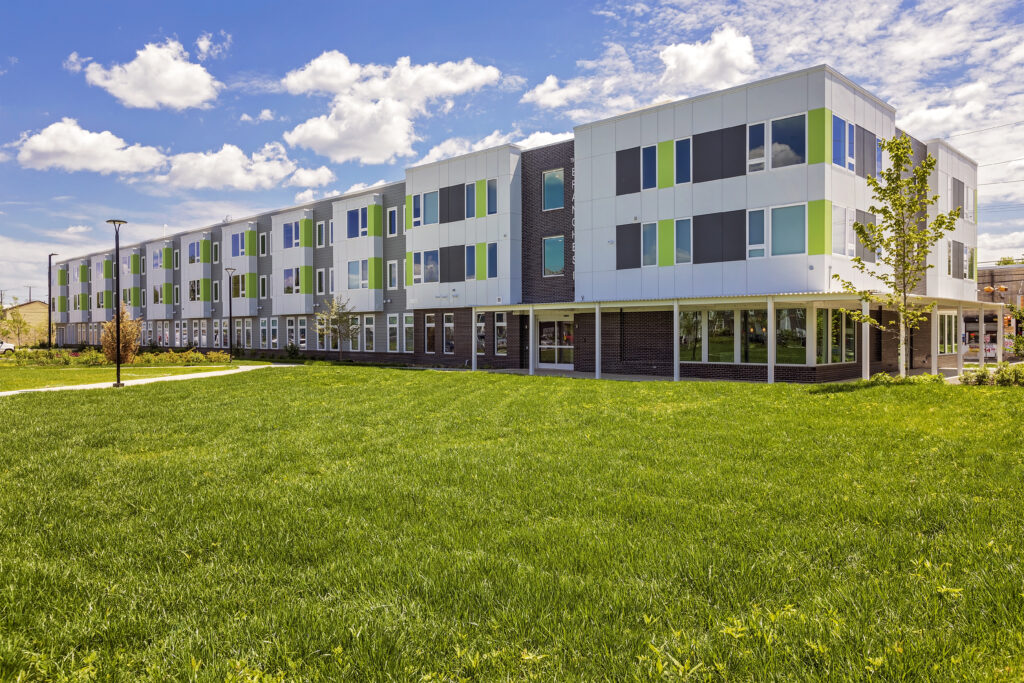
The Michaels Organization. Branch Village, Camden, NJ. Project Credit: Urban Practice. Photo Credit: Left Eyed Studios
The Branches II, Camden, NJ, Urban Practice
The Branches II is a 3-story affordable apartment building located in Camden, New Jersey. Designed by Urban Practice and developed by The Michaels Organization, this new home for 58 families was completed in 2021 and is the fourth phase of a larger development project.
+++

Joshua Zinder, AIA LEED AP is founder and managing partner of JZA+D, and a past-president of AIA-New Jersey. His portfolio, amassed over 30-plus years, includes office, hospitality, institutional, government, and mixed-use environments. He is a co-developer of multiple real estate properties in Princeton, where he lives and works. He currently serves on the Executive Board of the AIA National Small Firms Exchange and AIA Interfaith Design Knowledge Committee Board.
By Stacey Ruhle Kliesch, AIA, AIA NJ Advocacy Consultant | Posted in AIA Central New Jersey, AIA-NJ News, Business | Tagged: #AffordableHousing, #ClaudiaBitranAICPPP, #DavidJMinnoAIAPP, #FairHousingAct, #JoshuaZinderAIA, #missingmiddle, #PS&SArchitectureandEngineering, #StephenLSchochAIALEEDAP, #ValueOfTheArchitect | Comments (0)
Architects are creative professionals, educated, trained, and experienced in the art and science of building design, and licensed to practice architecture. Their designs respond to client needs, wants and vision, protect public safety, provide economic value, are innovative, inspire and contribute positively to the community and the environment.

414 Riverview Plaza, Trenton, NJ 08611
(609) 393-5690
info@aia-nj.org